Sight Picture Geometry: Why Dual Picture Sights Outperform Traditional Iron Sights
Traditional iron sights force shooters to fight against the physics of their own eyes. Three focal planes. One moment to aim. Zero margin for misalignment. For over a century, sight picture geometry has demanded that shooters consciously process information their eyes struggle to deliver clearly.
Most iron sight designs are geometric compromises. They favor speed or precision—never both. Wider rear notches accelerate acquisition but sacrifice accuracy. Thinner notches improve sight picture precision but slow you down when fractions of a second matter most. This tradeoff has persisted because conventional designs ignore how the human eye actually works.
Understanding sight picture geometry reveals why this compromise was never necessary. The eye has natural reflexes that traditional notch-and-post designs fail to exploit. When you understand the geometry your eye prefers, you understand why Dual Picture Sight technology delivers 19% faster target acquisition and 21% better accuracy—without forcing you to choose between them. Dual Picture Tritium Night Sights apply these geometric principles to give shooters an immediate advantage in any lighting condition.
The Three-Plane Problem in Iron Sight Geometry
Every shooter using iron sights faces the same fundamental obstacle. The rear sight, front sight, and target exist at three different distances from your eye. Your visual system can only focus clearly on one of these planes at any moment. This limitation is biological, not technical—and it shapes every aspect of iron sight picture geometry.
One Eye, Three Distances
When you raise a pistol to aim, your eye confronts an impossible task. The rear sight sits roughly 6 inches from your face. The front sight extends another 4 to 7 inches beyond that. Your target may be 7 yards away—or 25. According to Outdoor Life’s guide on shooting iron sights, your eye can only focus clearly on one plane, leaving the other two in varying degrees of blur. This creates the fundamental challenge of sight picture acquisition with any iron sight system.
This creates a geometric problem with real consequences. Any angular misalignment between your eye and the sights produces an error that grows with distance. A tiny shift at the rear sight becomes a significant miss at the target. The Gun Digest handbook on pistol marksmanship explains that this misalignment represents two diverging lines—and the error expands rapidly the farther the bullet travels. Your sight picture must account for this geometry every time you press the trigger.
Traditional Sight Picture Geometry Forces a Tradeoff
Conventional notch-and-post sights require conscious geometric processing. You must center the front post in the rear notch with equal light on both sides. The tops of both sights must align on the same horizontal plane. Winchester’s guide on sight alignment describes this as the foundation of accuracy—but it’s also the foundation of the speed-versus-precision compromise.
Consider what happens when you verify this alignment. Your brain must process multiple geometric relationships simultaneously. Is the front post centered? Is there equal daylight on both sides? Are the tops level? Each verification takes time—time you may not have in a defensive situation.
In high-stress defensive situations, this geometric processing presents a serious problem. Traditional solutions force you to accept wider notches for faster acquisition—sacrificing the precision you need at distance. Or you accept thinner notches for accuracy—sacrificing speed when every fraction of a second counts. Ghost ring sights and big-dot designs each abandon one capability to prioritize the other.
The NRA’s analysis of front sight focus confirms that precision shooting with iron sights has traditionally required focusing on the front sight and holding a 6 o’clock sight picture—a technique that demands time and cognitive bandwidth. Speed shooting forces different compromises. No conventional geometry serves both purposes well.
North Forest Arms eliminates that tradeoff entirely by applying geometric principles the human eye already prefers.
What Happens When You Focus on the Front Sight?
Every marksmanship instructor teaches the same principle: focus on the front sight. This isn’t arbitrary. It’s the only geometric solution that works consistently with iron sights. However, understanding why reveals both the strength of this approach and the limitations of traditional sight design.
The Front Sight Focus Principle
The front sight is the only element that reveals where your pistol is actually pointing. When you focus on the target instead, both sights blur. You cannot detect small misalignments in your sight picture—and at distance, small angles produce large misses.
As one experienced shooter explains in his iron sight tutorial, this creates a counterintuitive requirement: “In order to hit your target, you must not look at it.” The target becomes secondary. What matters is the front sight and its relationship to the rear sight. Your sight picture depends on this relationship being correct.
The blur at the target plane is geometrically negligible. Any error from aiming at a slightly blurry target produces minimal deviation. However, failing to detect sight picture misalignment produces significant deviation—one that compounds with distance. So you focus on the front sight, accept the blur, and trust the geometry.
Why Trained Shooters Still Struggle Under Stress
Front sight focus works—when you have time to achieve it. But shifting your eye’s focal plane from a distant threat to a sight inches from your face takes measurable time. Under stress, that shift becomes unreliable. Your sight picture suffers.
Estimates suggest the eye requires 0.5 to 1 second to shift focal planes and stabilize. In a defensive encounter, you may not have that time. Moreover, adrenaline disrupts fine motor control and conscious processing. The geometric precision that traditional iron sights demand becomes exactly what stress makes difficult to achieve.
This is why conventional iron sights are described as either “fast” or “accurate”—rarely both. The sight picture geometry requires conscious effort, and conscious effort degrades under pressure. What shooters need is a sight picture geometry that engages natural reflexes rather than demanding trained habits that break down when stakes are highest.
Concentric Circles: The Sight Picture Your Eye Prefers
Human vision has reflexes that traditional sight designs ignore. One of the most powerful is the eye’s tendency to concentrically align circles. This reflex operates below conscious awareness. It doesn’t require training. And it provides the geometric foundation for a fundamentally different approach to sight alignment.
Natural Alignment Without Conscious Effort
When you present two circles to the human eye—one inside the other—the eye automatically attempts to center them. You actually have to fight against this tendency to maintain an off-center alignment. This reflex is so strong that Wikipedia’s entry on iron sights identifies it as the basis for aperture sight accuracy through “parallax suppression.”
Aperture sights exploit this phenomenon. When the aperture diameter is smaller than the eye’s pupil, the aperture becomes the entrance pupil for your entire visual system. The eye naturally centers the front sight within the rear aperture—without requiring you to consciously verify spacing or alignment. Traditional iron sights ignore this reflex entirely.
Additionally, smaller apertures provide greater depth of field. This means the target appears less blurry when you focus on the front sight. The geometry works with your eye instead of against it.
How Dual Picture Sights Apply This Geometry
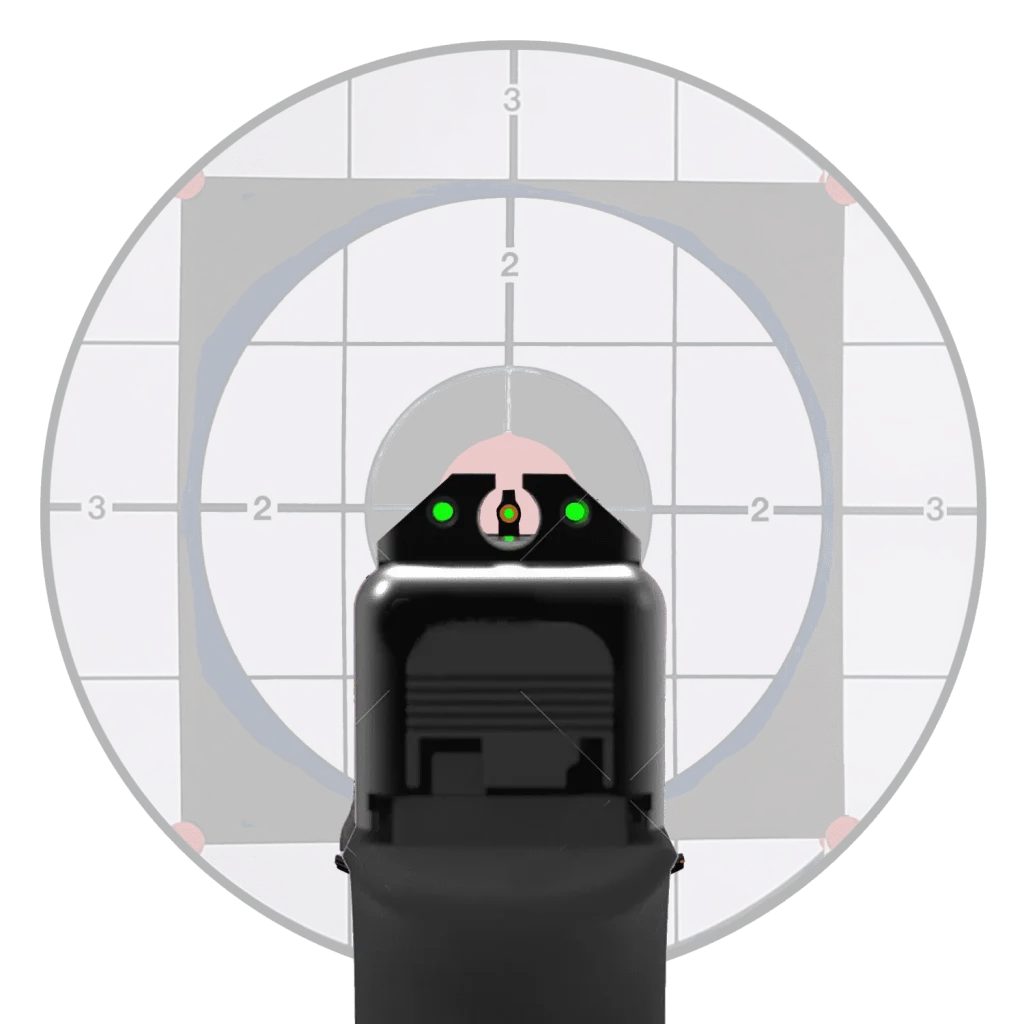
North Forest Arms Dual Picture Sights combine a large, clearly visible front dot with a circular rear aperture. This configuration triggers the eye’s concentric alignment reflex immediately upon presentation.
The result is instinctive front sight focus. Your eye centers the circles without conscious input from your brain. You don’t process spacing or verify level alignment—your visual system handles the geometry reflexively. This happens because the eye perceives misalignment as visually uncomfortable. Centering the circles feels natural. Fighting against that centering requires deliberate effort.
This reflex operates faster than conscious thought. Where traditional sights require you to think through the alignment process, concentric geometry bypasses that cognitive layer entirely. The eye knows immediately when alignment is correct—and attempts to correct it when it’s not.
As verified customer Dan M. describes it: “The big orange dot in the ‘ghost ring’ as the third sight alignment… the orange front dot draws my eyes focus to the front sight which is arguably the best way to sight.” He identifies exactly what the geometry achieves—automatic front sight focus without conscious effort.
Professional instructor Greg F. reinforces this observation: “The vertical alignment component is notably faster for a more precise shot but where it really blew my mind was in something I hadn’t considered.” As an instructor who emphasizes decision support over front-sight-focused training, he found that Dual Picture Sights deliver faster flash sight pictures for defensive shooting—geometry working with instinct rather than against it.
Two Sight Pictures, One Geometric System
Speed and precision typically require different sight geometries. Fast acquisition favors large, high-contrast elements that the eye picks up quickly. Precision favors thin, exact reference points that reveal small misalignments. Dual Picture Sights provide both—in a single system that adapts to the shooter’s needs.
The Fast Acquisition Sight Picture
For close-range defensive scenarios, the circle-in-circle geometry dominates. You see the large front dot. You see the circular rear aperture. Your eye centers them concentrically—and your sight picture is aligned.
This sight picture doesn’t require processing notch spacing. You don’t verify that tops are level. The geometry is self-correcting: if the circles aren’t centered, your eye notices immediately and attempts to fix it. Speed comes from eliminating the conscious verification steps that traditional iron sights demand.
At typical defensive distances—under 10 yards—this acquisition speed translates directly to performance. When speed outweighs surgical precision, the concentric sight picture geometry delivers. With tritium night sights, this fast acquisition works identically in daylight or complete darkness.
The Precision Sight Picture
For longer-range shots where the front dot would obscure a smaller target, Dual Picture Sights offer a second sight picture geometry. The thin notch and post allow precise alignment when you need to place shots with exactness.
This preserves traditional iron sight geometry for shooters who require it. The same sight system serves both purposes. You don’t change equipment for different scenarios—you simply use the sight picture appropriate to the situation. The transition between sight pictures is immediate—no adjustment period, no relearning.
Verified customer Matt explains the practical value: “With the half moon cuts I can easily pick up my target. If I want a line up a precision shot that is easily achievable as well.” The dual sight picture geometry delivers both capabilities in a single system.
This adaptability matters in defensive contexts where engagement distance changes rapidly. Iron sights that serve only close range leave you compromised at distance. Iron sights that serve only precision leave you slow up close. Dual Picture sight picture geometry eliminates both limitations.
For competitive shooters, this dual capability proves equally valuable. Bullseye precision and speed drills typically require different sight systems—or accepting suboptimal performance in one discipline. Glock night sight upgrades that offer both sight picture capabilities expand the drills and activities available without equipment changes.
Does Sight Picture Geometry Affect Real-World Performance?
Geometric principles sound compelling in theory. What matters is whether they translate to measurable results. North Forest Arms conducted controlled trials to quantify exactly what their sight geometry produces.
Trial Results: 19% Faster, 21% More Accurate
The initial trial involved 15 participants of varying ages and skill levels. None had prior experience with Dual Picture Sights. All had just completed a tactical class using their personal pistols with traditional iron sights or red dot sights.
Participants fired 10 shots with each pistol—one equipped with traditional iron sights, one with Dual Picture Sights. The MantisX X10 Elite measured results at 7-yard defensive distance.
Every single participant showed improved speed with Dual Picture Sights. The improvement ranged from 1% to 37%, with an average of 19%. All but one participant showed improved accuracy—ranging from 3% to 63%, with an average of 21%. The single participant whose accuracy decreased by 3% still gained 21% in speed.
These results came from first-time users with zero training on the new sights. The geometry worked immediately because it engages reflexes, not learned habits.
What the Data Means for Defensive Shooters
In high-stress altercations, engagement distance changes rapidly. A threat at 15 yards may close to contact distance in seconds—or you may need to engage at extended range to protect others. A sight geometry that adapts to both scenarios removes decision lag from an already chaotic situation.
Professional validation reinforces the data. Police departments have adopted Dual Picture Sights after independent review, including one that equipped their complete Special Response Team. When professionals who perform under stress for a living choose this geometry, the real-world implications are clear.
Why Does Front Sight Focus Matter More Than Target Focus?
This question appears frequently among shooters debating sight picture technique. The answer is geometric.
The front sight reveals alignment. The target does not. When you focus on a blurry target, you cannot see the small angular errors in your sight picture alignment—and those errors produce large misses at distance.
Target focus has legitimate applications, particularly at very close range where speed dominates precision requirements. But for any shot requiring accountability for placement, front sight focus remains the geometric standard for iron sights.
The advantage of concentric sight picture geometry is that it achieves front sight focus reflexively. Your eye naturally centers circles, which means your eye naturally focuses at the front sight plane. You get the geometric precision of front sight focus without the conscious processing delay. This is why Dual Picture Tritium Night Sights work immediately for first-time users—the sight picture geometry triggers reflexes rather than requiring learned technique.
Can Aging Eyes Still Benefit from Geometric Sight Design?
Vision changes with age. Presbyopia—the gradual loss of near-focus flexibility—affects most shooters eventually. Traditional sight geometry becomes harder to use as crisp front sight focus becomes physiologically more difficult. What was once automatic requires conscious effort. What was once comfortable becomes straining.
Concentric alignment engages a reflex that doesn’t depend on crisp vision. The eye’s tendency to center circles operates even when those circles appear somewhat blurred. The reflex recognizes “centered” versus “off-center” without requiring sharp edges or fine detail. Shooters with age-related vision changes consistently report improved performance with Dual Picture Sights.
Verified customer Ron, age 79, confirms this directly: “I’m 79yo and these sites are awesome. Your right on target and shooting beyond 20 yards my grouping is much tighter.” The geometry works with his eyes as they are—not as they were decades ago. His tighter groupings at extended distance demonstrate that concentric alignment delivers precision even when traditional front sight focus becomes challenging.
For shooters in low-light environments where vision is further compromised, tritium illumination ensures the geometric references remain visible when ambient light fails. Swiss tritium glows consistently for years, providing reliable sight acquisition regardless of lighting conditions.
How Dual Picture Tritium Night Sights Use Geometry to Your Advantage
Traditional iron sights demand that your eye conform to their sight picture geometry. They require conscious processing of spacing, alignment, and level—tasks that become unreliable under stress and increasingly difficult with age.
Dual Picture Sights reverse this relationship. The sight picture geometry conforms to your eye’s natural reflexes. Concentric alignment happens automatically. Front sight focus occurs instinctively. The precision picture remains available when distance demands it.
The result is measurable: 19% faster target acquisition and 21% better accuracy in controlled trials with first-time users. No special training required—because the geometry leverages reflexes you already possess.
When you compare tritium vs fiber optic sights, tritium night sights offer consistent visibility in any lighting condition. Swiss tritium glows reliably for years, ensuring your sight picture geometry works whether you’re at an indoor range or defending your home at 3 AM.
Ready to experience the sight picture your eye already prefers? Shop Dual Picture Tritium Night Sights for Glock or SIG Sauer models—and discover why shooters call these the best iron sights they’ve ever used. Need help with installation? Our step-by-step guide makes upgrading straightforward.